
Plantar Fasciitis: A Shoreham Physio Explains Why Your Heel Hurts First Thing in the Morning
You wake up, swing your legs out of bed, put your foot on the floor… and it feels like you’ve stepped on a drawing pin.
After a few awkward steps it eases off, only to return after standing for long periods or later in the day.
If that sounds familiar, you’re certainly not alone. Plantar fasciitis is one of the most common causes of heel pain we see at Shore Health Physio in Shoreham. The reassuring news is that, despite how stubborn it can feel, the vast majority of cases respond very well once we identify what’s overloading the tissue and create a structured plan to calm it down.
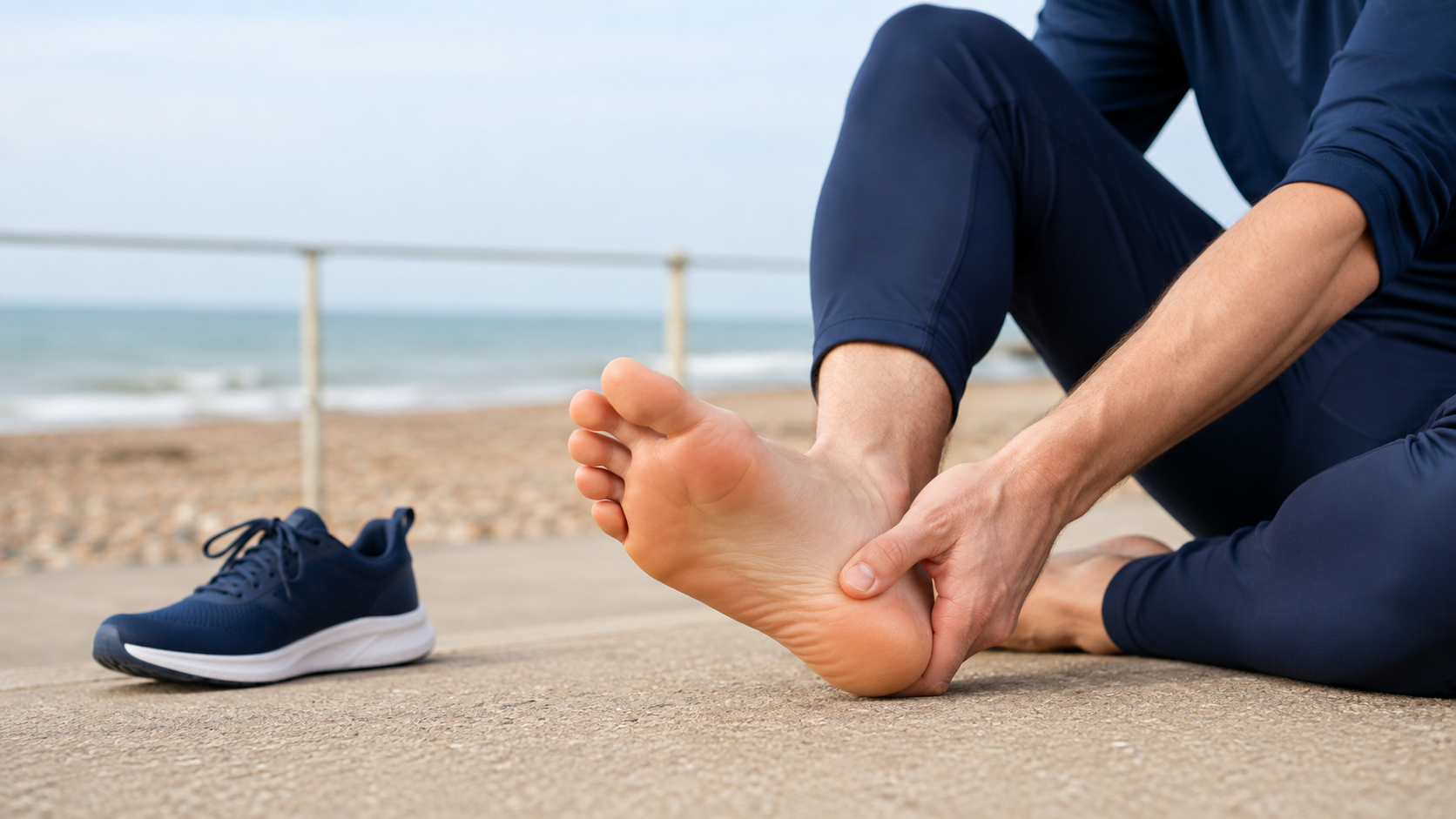
What Is Plantar Fasciitis?
The plantar fascia is a thick, fibrous band of connective tissue that runs along the sole of your foot, connecting your heel bone (the calcaneus) to the base of your toes.
Its job is to help maintain the arch of your foot, absorb force and efficiently transfer load every time you walk, run or stand.
Although the name plantar fasciitis suggests inflammation, we now know that many longer-lasting cases behave much more like an overloaded tendon than an inflamed tissue. Rather than being torn or permanently damaged, the fascia has simply been asked to tolerate more load than it’s currently capable of managing.
This is actually good news.
It means your foot isn’t “wearing out” or falling apart—it simply needs the right balance of reducing irritation while gradually rebuilding its capacity to cope with everyday life again.
What Does Plantar Fasciitis Feel Like?
Most people describe:
Sharp, stabbing pain underneath the heel with the first few steps in the morning.
Pain after standing up following prolonged sitting.
Symptoms that ease after a few minutes of walking before gradually returning later in the day.
Tenderness when pressing the inside of the heel bone.
A dull ache after prolonged standing or walking on hard surfaces.
Pain following an increase in walking, running or time spent on your feet.
A common story we hear is someone returning from a city break around Brighton, spending a weekend exploring the South Downs, starting a new job involving long hours standing, or deciding to train for their first 10K—only to develop heel pain a few weeks later.
Why Does It Happen?
The plantar fascia is remarkably strong.
Like every tissue in the body, however, it has a limit to how much stress it can tolerate.
When the demands placed upon it exceed that capacity—whether through increased walking, running, standing, changes in footwear or simply cumulative time on your feet—the tissue becomes irritated and sensitised.
Pain is therefore not necessarily a sign of damage.
Instead, it’s your body’s way of telling you that the current workload exceeds what the fascia is prepared for.
This concept is one of the most important things for people to understand because it shifts the goal away from “fixing something that’s broken” towards gradually increasing the tissue’s tolerance again.
Common Causes of Plantar Fasciitis
Although symptoms often seem to appear overnight, there’s usually been a gradual increase in stress beforehand.
Common contributors include:
Suddenly increasing walking or running.
Long shifts standing at work.
Spending prolonged periods barefoot on hard floors.
Wearing unsupportive footwear or worn-out trainers.
Returning to exercise after time away.
Tight calf muscles limiting ankle mobility.
Increased body weight increasing daily load through the feet.
Occupations such as healthcare, retail, hospitality, teaching and manual trades where prolonged standing is unavoidable.
Often it’s not one single event—but several small changes occurring together.
How to Manage Plantar Fasciitis
You’ll find thousands of videos online recommending stretches.
While mobility work certainly has a place, successful treatment usually involves managing the overall amount of load passing through the fascia while allowing it to recover.
Some of the most effective strategies include:
Wear supportive footwear—even indoors
Walking barefoot across kitchen tiles or wooden flooring repeatedly loads the irritated tissue. A supportive trainer or firm slipper around the house often makes a surprisingly large difference.
Avoid flip-flops for now
Flat footwear provides very little support or shock absorption.
This doesn’t mean you’ll never wear sandals again—it simply helps reduce unnecessary irritation during recovery.
Consider an off-the-shelf insole
Many people gain short-term symptom relief from a supportive insole or heel cup that redistributes pressure away from the painful area.
Custom orthotics are rarely the first step.
Reduce aggravating load—not all activity
Completely stopping exercise often isn’t necessary.
Instead, identify what’s driving the symptoms and temporarily reduce it.
That might mean:
Fewer running miles.
Breaking up long periods of standing.
Choosing flatter walking routes.
Swapping high-impact exercise for cycling or swimming temporarily.
Ice can help symptoms
Rolling the sole of the foot over a cold bottle or applying ice after a particularly demanding day may reduce discomfort.
It won’t solve the underlying problem on its own, but it can help settle irritation.
Manage cumulative time on your feet
Regular short breaks throughout the day are often more effective than trying to push through increasing pain.
Recovery is usually about managing the total daily load—not simply one individual activity.
Common Mistakes That Keep Plantar Fasciitis Going
Many people unintentionally prolong their symptoms by:
Walking barefoot because it “feels natural.”
Stretching aggressively without reducing the activity causing the overload.
Continuing to push through worsening pain.
Buying expensive custom orthotics before addressing the underlying cause.
Resting completely for weeks, allowing the tissue to become less tolerant of activity.
Successful rehabilitation isn’t about finding one magic exercise.
It’s about finding the right balance between protecting the tissue enough for symptoms to settle while progressively rebuilding its strength and resilience.
Strength Matters More Than Many People Realise
Once symptoms have settled, progressive strengthening becomes one of the most important parts of recovery.
Like tendons elsewhere in the body, the plantar fascia responds positively to gradually increasing load.
Strengthening the calf muscles, foot muscles and the rest of the lower limb improves the body’s ability to absorb force efficiently and may reduce the likelihood of symptoms returning.
This is often where physiotherapy makes the biggest long-term difference—not simply getting you out of pain, but helping stop the cycle repeating.
Is It Definitely Plantar Fasciitis?
Not always.
Although plantar fasciitis is the most common cause of heel pain, several other conditions can produce remarkably similar symptoms.
These include:
Heel fat pad syndrome.
Calcaneal stress reaction or stress fracture.
Baxter’s nerve entrapment.
Tarsal tunnel syndrome.
Achilles tendon disorders.
Referred pain from the lower back.
This is one reason why persistent heel pain deserves an accurate assessment rather than simply assuming the diagnosis from Google.
What About Heel Spurs?
Many people are told they have a heel spur after having an X-ray and naturally assume that’s what’s causing their pain.
In reality, heel spurs are extremely common in people who have absolutely no heel pain at all.
They’re often an incidental finding rather than the true source of symptoms.
Our focus isn’t on treating an X-ray—we treat the irritated tissue, identify what’s overloading it and restore its ability to tolerate everyday life again.
When Should You See a Physiotherapist?
It’s worth seeking an assessment if:
Symptoms haven’t started improving after several weeks.
Heel pain is affecting work, walking or exercise.
The pain keeps returning despite periods of improvement.
You experience numbness, pins and needles or pain travelling into the foot or leg.
You’re simply unsure whether it’s plantar fasciitis or something else.
At Shore Health Physio we’ll assess far more than just your foot.
We’ll look at your footwear, calf strength, ankle mobility, walking mechanics, training history, workplace demands and overall activity levels before creating an individual rehabilitation programme designed around your goals.
Frequently Asked Questions
Why is plantar fasciitis worse first thing in the morning?
While you sleep, the plantar fascia shortens slightly. The first few steps place sudden tension through an already sensitive tissue, creating the characteristic sharp pain before it gradually warms up.
How long does plantar fasciitis take to recover?
Many people notice significant improvement within six to eight weeks once the load is managed appropriately, although persistent cases may take several months. Recovery is usually faster when symptoms are addressed early.
Can I still run with plantar fasciitis?
Often yes.
Rather than stopping completely, it’s usually more effective to temporarily reduce mileage, intensity or frequency while gradually rebuilding the tissue’s tolerance.
Should I wear shoes indoors?
Yes.
Supportive footwear indoors is one of the simplest changes many people can make to reduce repeated irritation through the heel.
Do I need a scan?
Usually not.
Plantar fasciitis is most commonly diagnosed through a detailed history and physical examination. Scans are generally reserved for symptoms that aren’t progressing as expected or where another diagnosis is suspected.
⸻
Looking for a Physio in Shoreham-by-Sea?
If heel pain is stopping you enjoying long walks, affecting your running or simply making those first few steps every morning miserable, we’d be happy to help.
At Shore Health Physio, we provide evidence-based assessment and rehabilitation for plantar fasciitis, heel pain and lower limb injuries for people across Shoreham-by-Sea, Southwick, Lancing, Worthing, Hove, Brighton and the wider West Sussex area.
Our aim isn’t simply to settle your symptoms—it’s to understand why they’ve developed, address the underlying causes and help you return to the activities you enjoy with confidence.
⸻
About the Author
Written by CJ Bestwick MSc, BSc (Hons), MCSP
Founder of Shore Health Physio | Chartered Physiotherapist
CJ Bestwick is a Chartered Physiotherapist with a Master’s degree in Sports & Exercise Medicine and over a decade of experience treating musculoskeletal injuries. Alongside running Shore Health Physio in Shoreham-by-Sea, he works within one of London’s leading private physiotherapy clinics, assessing and treating everyone from recreational runners to elite athletes, surgeons, executives and professional performers.